
Nestled in the heart of Kolkata’s legendary College Street, the Indian Coffee House stands as more than just a café—it’s a living monument to Bengal’s intellectual heritage and cultural awakening. For over eight decades, this iconic establishment has witnessed the birth of revolutionary ideas, nurtured literary movements, and served as the unofficial parliament of Bengal’s intelligentsia.
Historical Journey: From Albert Hall to Cultural Icon
Origins as Albert Hall (1876) and Colonial Heritage
The remarkable story of Indian Coffee House begins in 1876 when the building was constructed as Albert Hall, named after Prince Albert, Queen Victoria’s consort. Originally owned by Ramkamal Sen, the grandfather of Brahmo leader Keshab Chandra Sen, this stately mansion served as a residence and later became the headquarters of various intellectual societies.
The building witnessed significant historical moments, including the establishment of the Bharat Sabha (Indian Association) by prominent leaders like Surendranath Bandyopadhyay and Anand Mohan Bose, making it a center for anti-British movements even before its transformation into a coffee house.
Transformation to Coffee House (1942-1947)
In 1942, the Coffee Board of India decided to convert Albert Hall into a coffee establishment, marking the beginning of its journey as a cultural institution. The transformation was part of a broader initiative to establish coffee houses across India, but few would achieve the cultural significance of the College Street branch.
Following India’s independence in 1947, the Central Government officially renamed it “Indian Coffee House,” cementing its identity as a symbol of India’s new cultural awakening. When the Coffee Board attempted to shut down operations in 1958, professors from Presidency College and Calcutta University petitioned the government, leading to its reopening under the Indian Coffee Workers’ Cooperative Society.
Cultural Renaissance and Famous Patrons
Understanding Adda Tradition in Bengal
At the core of Indian Coffee House’s cultural significance lies the Bengali tradition of “adda”—informal yet intellectually stimulating discussions that can span hours and cover everything from politics to philosophy. This tradition, which has no direct English equivalent, represents the essence of Bengali social and intellectual life.
The coffee house became the perfect venue for adda, with its spacious halls, comfortable seating arrangements, and tolerant atmosphere where patrons could occupy tables for extended periods while nursing a single cup of coffee. The management’s message on the wall—”Please remember, there are also others”—gently reminded patrons to keep discussions at reasonable volumes while respecting the communal nature of the space.
Intellectual Discussions and Literary Movements
The coffee house played a pivotal role in nurturing Bengal’s literary and cultural movements. During the 1960s, it became the meeting ground for the revolutionary Hungry Generation poets, including Malay Roy Choudhury and Samir Roychoudhury, whose avant-garde literary works challenged conventional artistic norms.
The establishment witnessed countless debates on literature, politics, science, and social issues, with discussions often extending late into the evening. These conversations weren’t merely casual chatter but serious intellectual exchanges that influenced artistic works, political movements, and social reforms.
Student Life and Academic Hub
Located directly opposite Presidency University (formerly Presidency College) and surrounded by other prestigious educational institutions, the coffee house naturally became a second home for students. Generations of scholars, future Nobel laureates, and prominent intellectuals spent their formative years engaging in spirited debates within these walls.
The proximity to College Street’s famous book market created a unique ecosystem where academic learning seamlessly blended with practical intellectual engagement.
Architecture and Ambiance
Colonial-Era Building Design and High Ceilings
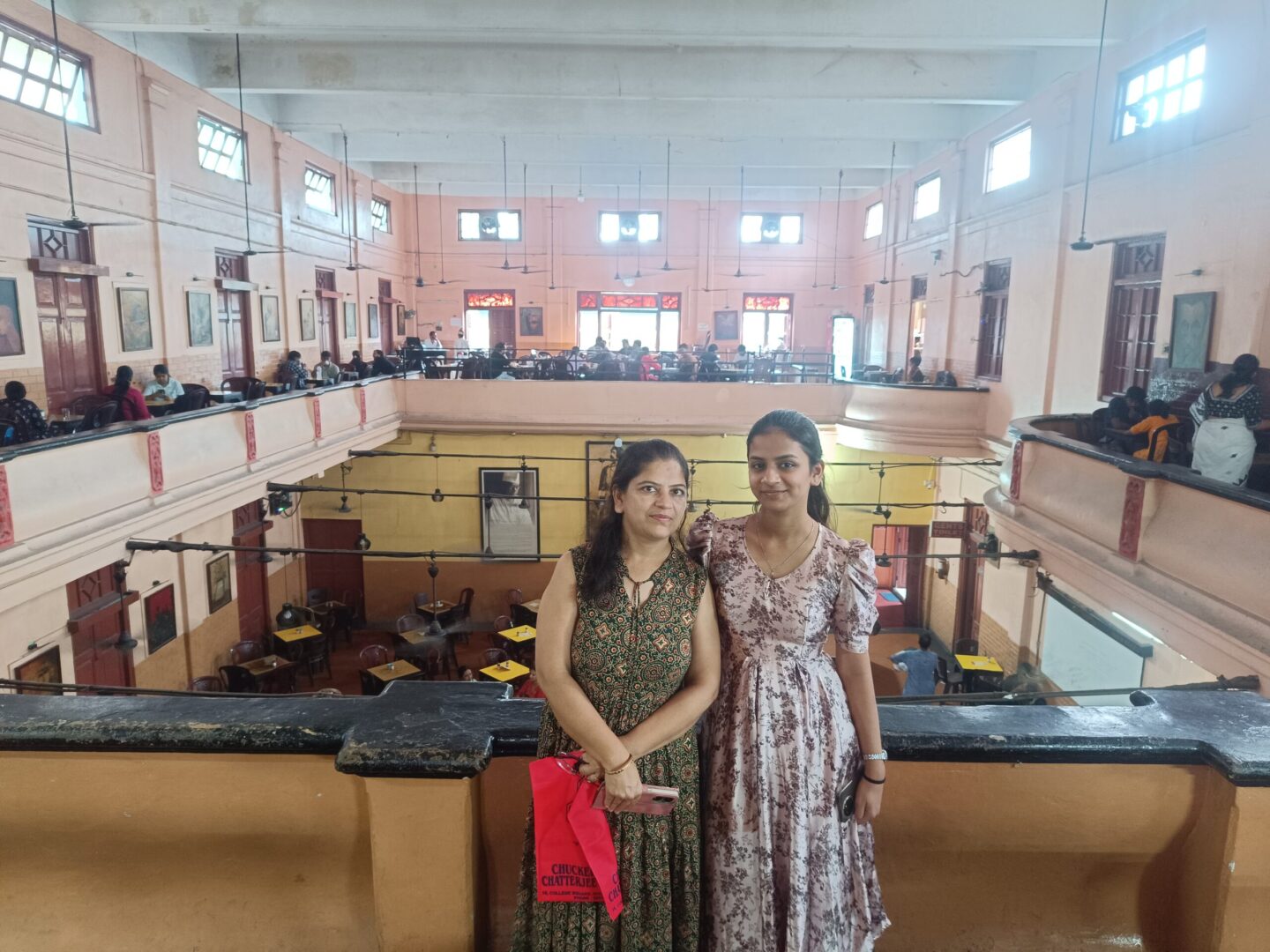
The Indian Coffee House occupies a magnificent colonial-era building that reflects the architectural grandeur of 19th-century Calcutta. The structure features impressively high ceilings, large windows that flood the interior with natural light, and spacious halls designed for public gatherings.
Vintage Furniture and Interior Layout
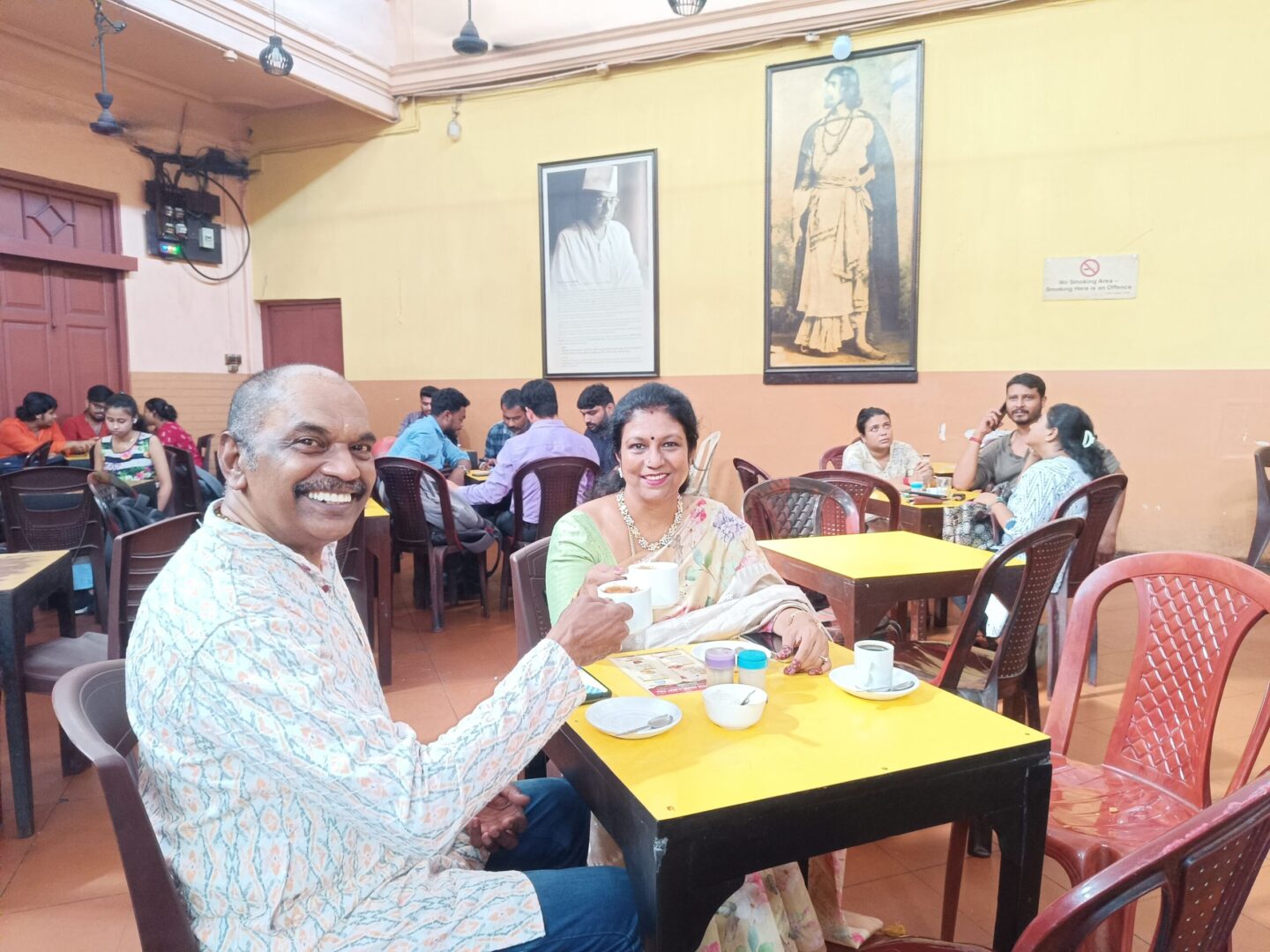
The interior maintains its old-world charm with vintage wooden furniture, simple tables and chairs arranged for communal dining, and archaic ceiling fans that have witnessed decades of conversations. The walls are adorned with portraits of literary giants, including a prominent photograph of Rabindranath Tagore, India’s first Nobel laureate in Literature.
The coffee house staff, dressed in traditional white uniforms with red belts and distinctive turbans, add to the establishment’s authentic heritage atmosphere. These servers, some of whom have worked there for decades, become familiar faces to regular patrons and maintain the traditions that make each visit memorable.
Two-Floor Amphitheater Setting
The layout features a ground floor with approximately thirty tables and a mezzanine level that overlooks the main hall, creating an amphitheater-like setting perfect for intellectual discussions. This architectural design allows for multiple conversations to occur simultaneously while maintaining the communal atmosphere that defines adda culture.
Famous Patrons and Cultural Legacy
Literary Giants: Tagore, Ray, and Contemporary Writers
The coffee house has hosted an extraordinary array of cultural luminaries throughout its history. Rabindranath Tagore, India’s Nobel Prize-winning poet, was a regular patron who found inspiration within these walls. Satyajit Ray, the internationally acclaimed filmmaker, spent countless hours here discussing cinema and art with fellow creatives.
Other notable literary figures include Sunil Gangopadhyay, Shakti Chattopadhyay, Subhas Mukhopadhyay, and Narayan Gangopadhyay, all of whom contributed significantly to modern Bengali literature while finding intellectual stimulation in the coffee house’s vibrant atmosphere.
Freedom Fighters and Political Leaders
The establishment played a crucial role during India’s independence movement, serving as a meeting place for freedom fighters and political activists. Netaji Subhash Chandra Bose was sworn in as Congress president in the 1920s at the coffee house, marking a significant moment in India’s political history.
The coffee house provided a safe space for political discussions, strategy planning, and the exchange of revolutionary ideas that contributed to the broader independence movement.
International Visitors and Beat Poets
The coffee house’s reputation extended beyond India’s borders, attracting international intellectuals and artists. In 1962, beat poet Allen Ginsberg spent several afternoons here with Jack Kerouac and local poets, engaging in cross-cultural literary exchanges. German author Gunter Grass was a regular visitor during his five-month stay in Kolkata during the 1980s.
These international connections helped establish the coffee house as a globally recognized center of intellectual activity.
Visiting Information and Practical Tips
Location, Timings, and How to Reach
Address: 15, Bankim Chatterjee Street, College Square West, College Street, Kolkata 700073
Timings: Daily 12:00 PM to 8:00 PM (including weekends)
How to Reach:
-
Nearest Metro Station: MG Road, Central and Sealdah
-
By Bus: Buses to College Square or College Street
-
Location: Directly opposite Presidency University, accessible through a narrow lane between bookstalls
Frequently Asked Questions
What are the opening hours of Indian Coffee House College Street?
Indian Coffee House College Street is open daily from 12:00 PM to 8:00 PM, including weekends. However, timings may vary during festivals and national holidays.
What is the history behind Indian Coffee House College Street?
Originally built as Albert Hall in 1876, it was converted into a coffee house by the Coffee Board in 1942. The Government renamed it ‘Indian Coffee House’ in 1947. It has been a cultural hub for intellectuals, writers, and freedom fighters for over 80 years.
What is 'adda' culture at Indian Coffee House?
Adda is a Bengali tradition of informal intellectual discussions over coffee or tea. Indian Coffee House has been the epicenter of adda culture, where students, writers, and intellectuals gather to debate politics, literature, philosophy, and current affairs.
What are the must-try dishes at Indian Coffee House College Street?
Must-try items include Special Coffee, Chicken Sandwich, Fish Kabiraji, Chicken Cutlet, Mutton Afghani, and their famous filter coffee. Most dishes are priced under ₹200.
Which famous personalities have visited Indian Coffee House?
Notable patrons include Rabindranath Tagore, Satyajit Ray, Amartya Sen, Mrinal Sen, Subhash Chandra Bose, Manna Dey, Sunil Gangopadhyay, Allen Ginsberg, and many other literary figures and freedom fighters.
How do I reach Indian Coffee House College Street?
Located at 15 Bankim Chatterjee Street, College Street. Nearest metro station is Park Street. Take buses to College Square or College Street. The coffee house is opposite Presidency University, accessible through a narrow lane between bookstalls.
What makes Indian Coffee House College Street special compared to other branches?
The College Street branch is the most famous and culturally significant of all Indian Coffee House outlets. Its proximity to Presidency University, rich intellectual history, famous patrons, and role in Bengal’s cultural renaissance make it unique and historically important.
office hours
7:00am - 10:00pm (IST)
Address
87EE/16, Anupama Housing Complex, VIP Road, Kolkata, West Bengal, India - 700052


