
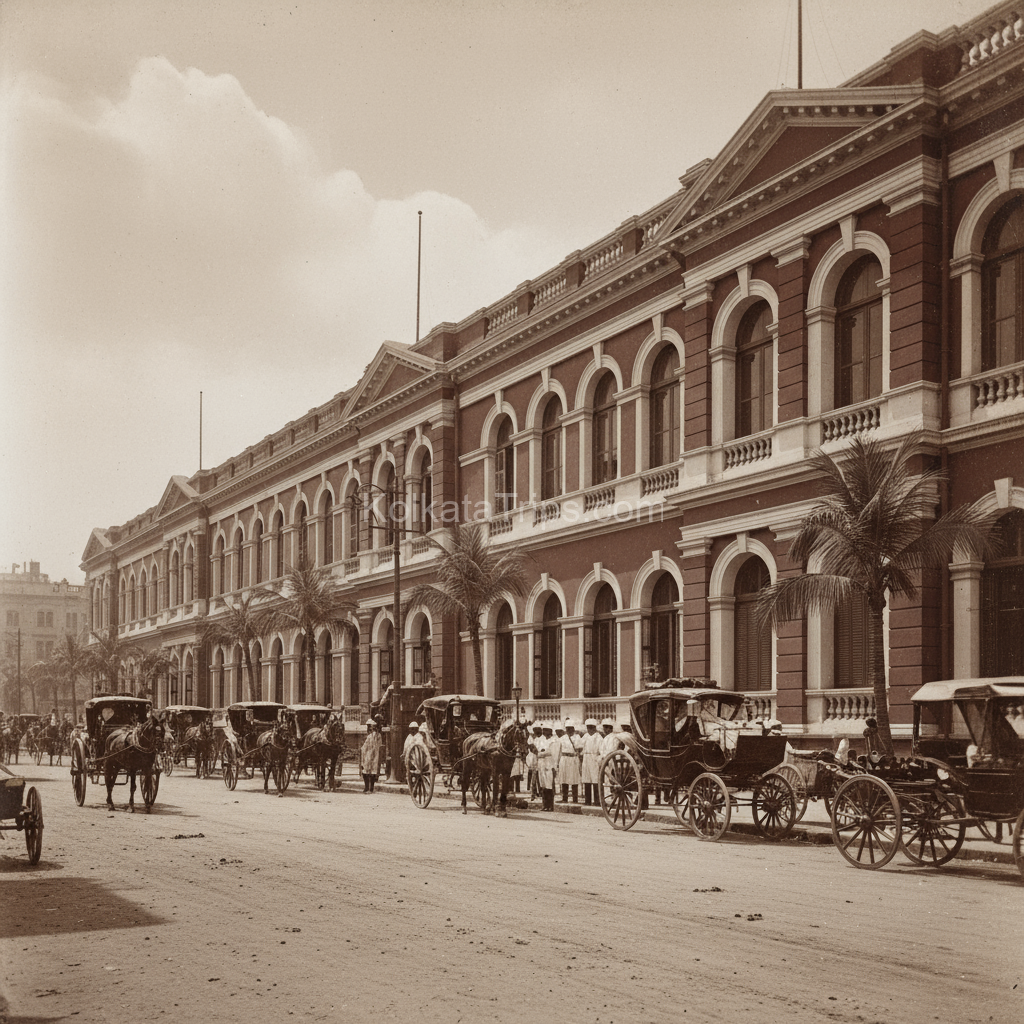
Set against the bustling backdrop of B.B.D. Bagh, the Writers’ Building is among Kolkata’s most storied landmarks—a testimony to both colonial rule and India’s administrative evolution. Its red-brick and neo-classical architecture, epic stories, and legacy as the seat of West Bengal’s government make it essential for history lovers and curious travelers alike.
Introduction & Historical Significance
Origin & Early Use by East India Company
The Writers’ Building earns its name from the “writers”—junior clerks of the British East India Company—who once lived and worked here. Designed by Thomas Lyon and completed in 1777, it was Kolkata’s very first three-storey structure, created to centralize Company operations and housing for administrative staff.
Occupying the former site of St. Anne’s Church (demolished for the new construction), the building quickly became the Company’s administrative headquarters. Notably, it marked the western boundary of British ‘White Town’—an enclave set apart from local residents as the city of Calcutta (now Kolkata) rapidly expanded.
Role in Colonial & Post-Colonial Governance
Beyond simply serving the Company, the Writers’ Building soon emerged as the heart of colonial governance in Bengal and the broader British Raj. It witnessed a steady expansion to accommodate the growing bureaucracy and, by the nineteenth century, became the focal point for government action in the region.
By the early 19th century, the building was expanded to house the famous Fort William College, which trained Company officials in Persian and Hindi—languages vital for administration in India. Additional hostels, libraries, classrooms, and a vast examination hall were added, bearing witness to evolving colonial needs.
Crucially, the Writers’ Building was also the site of major political events, most famously the 1905 Partition of Bengal orchestrated by Lord Curzon and the subsequent Swadeshi Movement. The building’s corridors became a hotbed for resistance, protests, and later, Indian independence activities.
Writers’ Building Architecture and Design
Neo-Classical & French Renaissance Influences
Visually, the Writers’ Building is an epic example of British-Indian colonial architecture, blending neo-classical, Greco-Roman, and French Renaissance styles. The facade stretches along the entire north side of Lal Dighi (the “Red Lake”) and is dominated by a vast central portico flanked by imposing colonnaded verandahs.
The building is celebrated for its elegantly symmetrical proportions and signature features:
-
A 128-foot-long verandah lined with 32-foot high Ionic columns
-
Mansard roofs and decorative statuary (added in later renovations)
-
Red-brick coloring, giving it its recognizable and somewhat austere appearance
Notable Features & Statues
Statues of Greek Gods and Goddesses representing Justice, Commerce, Science, and Agriculture—along with Indian and European scholars—adorn the rooftop, celebrating the ideals of enlightenment and progress. The roofline’s statuary and ornamental flourishes were part of 19th- and 20th-century enhancements, adding to the celebratory grandeur.
Inside, the building once featured spacious lecture halls, multiple libraries, a substantial hostel wing, and 19 residential quarters with signature triple windows. Later, as the secretariat expanded, additional office wings and staircases were constructed.
Renovations and Expansions
Originally a three-storey structure with 19 apartments, expansion over centuries added multiple blocks—today there are 13 distinct blocks, some from post-independence eras. Notably, the verandahs, porticoes, and several perpendicular blocks were not part of the original plan but created to adapt to growing government functions. Modern restoration efforts focus on balancing heritage conservation with administrative needs.
Visiting Writers’ Building
Location, Timings & Entry Fee
Centrally located at B.B.D. Bagh (Dalhousie Square), the Writers’ Building is easily accessible via all major Kolkata transit options.
-
Timings: Generally open for viewing from outside all day.
-
Interior access: Typically 10:00 AM to 5:00 PM, Monday to Friday, but entry is restricted to government officials and authorized tours.
-
Entry fee: None; the public may photograph and admire the exterior freely, but interior visits require advance permission or are part of guided heritage tours.
Access Policies & Restrictions
Due to its role as a government secretariat and said restoration works, entry to the interior is usually not permitted for tourists. The facade, however, remains an architectural star for photographers and travelers. During special events or heritage days, limited guided access may be offered through official channels.
Best Ways to View and Photograph
The Writers’ Building’s impressive length and stately colonnades are best admired from Lal Dighi’s lakeside promenade. Morning and late afternoon provide ideal lighting for photographs. Wide-angle shots capture the scale of the building, while close-ups reveal the details of its neoclassical columns and rooftop statues. Visiting on weekdays helps avoid crowds and offers the most tranquil views.
Cultural Legacy & Historic Events
Political Movements and Independence Struggle
The Writers’ Building has witnessed rallies, protests, and tragedy—most notably the 1930 attack by three young revolutionaries (Binoy Bose, Badal Gupta, and Dinesh Gupta) who targeted the dreaded British Inspector General, inspiring generations of freedom fighters. The building’s corridors and stairways echo with the voices of India’s struggle for independence and self-determination.
Post-Independence Role
Following independence in 1947, the Writers’ Building became the West Bengal’s secretariat, continuing its legacy as a site of power and governance. For more than 60 years, it housed the offices of the Chief Minister and cabinet members, shaping the region’s political landscape through decades of turbulent change, protests, and civic life.
Current Restoration
Recently, comprehensive restoration and modernization projects have been underway to preserve the Writers’ Building’s structural and historical integrity while updating it for current governmental use. Conservationists are working to maintain the building’s original character, from its stately verandahs to rear blocks and interior halls, ensuring that Kolkata’s next generations can continue to appreciate this architectural treasure.
Nearby Attractions and Places to Visit
General Post Office (GPO), Kolkata
Located close to Writers’ Building, the iconic General Post Office (GPO) is one of Kolkata’s most striking landmarks. Built in 1868, it features a massive dome and Corinthian pillars. The GPO serves as the central hub of the city’s postal services and attracts visitors for its grand colonial architecture.
St. Andrew’s Church, Kolkata
Just a short walk from Writers’ Building, St. Andrew’s Church is the only Scottish church in Kolkata. Built in 1818, its beautiful white façade and tall spire stand out against the cityscape. The church reflects neo-classical design and continues to be an active place of worship and heritage site.
Currency Building, Kolkata
Situated close to Writers’ Building, the Currency Building is a heritage structure dating back to 1833. Once used by the Reserve Bank of India for currency operations, it now showcases restored Italian-style architecture. The building hosts cultural exhibitions and stands as a reminder of Kolkata’s colonial and financial history.
Raj Bhavan, Kolkata
Near Writers’ Building lies Raj Bhavan, the official residence of the Governor of West Bengal. Completed in 1803, this grand colonial mansion is modeled after Kedleston Hall in England. With sprawling gardens and majestic architecture, Raj Bhavan is an important historical and political landmark in Kolkata’s heritage-rich city center.
Frequently Asked Questions
What is the Writers’ Building used for today?
It remains the administrative secretariat for the West Bengal state government, though ongoing renovations mean some offices have relocated temporarily.
Can tourists go inside Writers’ Building?
No, entrance to the inner chambers is generally restricted to government officials and authorized personnel. The exterior is always visible, and occasional guided tours are organized during heritage festivals.
What are the Writers’ Building opening hours?
The complex can be viewed from outside at any hour, but business hours for authorized personnel are 10:00 AM to 5:00 PM, Monday to Friday. Closed weekends and public holidays.
How do I reach Writers’ Building?
Located in the heart of B.B.D. Bagh, the building is easily accessed via Howrah/Sealdah railway stations, Netaji Subhas Chandra Bose International Airport (via taxi), Kolkata Metro, and city buses.
Is there an entry fee for Writers’ Building?
No, there’s no fee to visit or view from outside.
Why is it called Writers’ Building?
The East India Company called its clerks ‘writers’; the building served as their residence and workplace, hence the name.
office hours
7:00am - 10:00pm (IST)
Address
87EE/16, Anupama Housing Complex, VIP Road, Kolkata, West Bengal, India - 700052


